

Commentary
Angie Omar
{
  "authors": [
    "Angie Omar"
  ],
  "type": "commentary",
  "blog": "Diwan",
  "centerAffiliationAll": "",
  "centers": [
    "Carnegie Endowment for International Peace",
    "Malcolm H. Kerr Carnegie Middle East Center"
  ],
  "collections": [
    "The Iran War’s Global Reach"
  ],
  "englishNewsletterAll": "",
  "nonEnglishNewsletterAll": "",
  "primaryCenter": "Malcolm H. Kerr Carnegie Middle East Center",
  "programAffiliation": "",
  "regions": [
    "Egypt",
    "Iran",
    "United States",
    "Israel"
  ]
}
Source: Getty
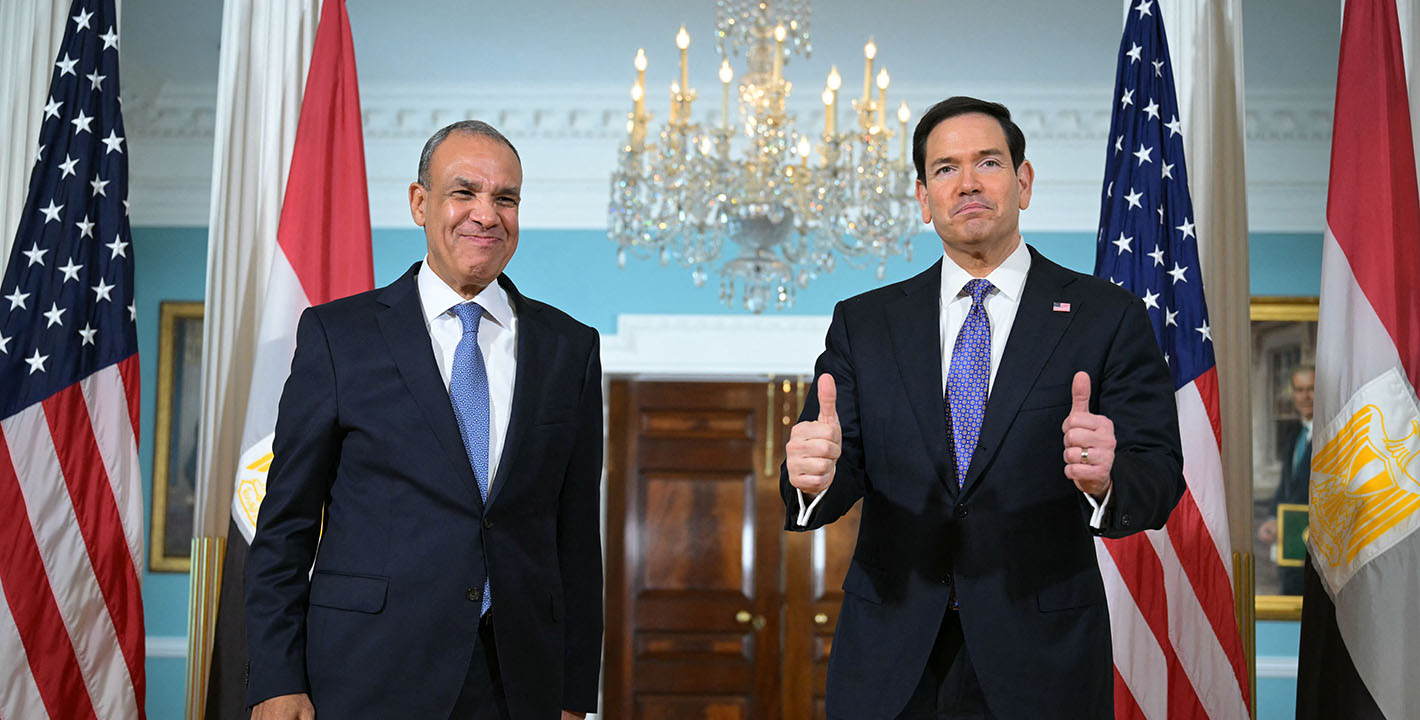
Cairo’s efforts send a message to the United States and the region that it still has a place at the diplomatic table.
Egypt has been on the sidelines as a mediator in Middle Eastern negotiations for much of the past decade, but its quiet role in facilitating the current ceasefire between the United States and Iran, alongside Türkiye and Pakistan, has brought the country back into the position it once held, in which it managed crises through discreet diplomacy.
Egypt’s involvement in helping secure a ceasefire between the United States and Iran was not highlighted in press conferences or framed as a major achievement. Its role seemed to be both tactical and strategic, through its facilitation of communications and narrowing differenced in the political and military confrontation between Washington and Tehran. Some analysis suggests that Egypt’s role was intentionally kept under the radar to avoid a major diplomatic conflict with Israel, which considers its war with Iran as having existential implications.
Diplomatic reporting suggests that Egypt’s part in the ceasefire came through intelligence-level contacts, a method that Egypt has used for decades. In this case, Egyptian officials appear to have helped establish a line of communication between Washington and Tehran at a moment when direct messaging was politically costly for both sides. Egyptian intermediaries reportedly relayed U.S. concerns about an escalation in the Gulf, while also transmitting Iranian warnings about potential retaliation if the conflict widened. This back-and-forth helped reduce the risk of miscalculation and allowed both sides to test possible off-ramps before making any public commitments.
Egypt’s General Intelligence Service (GIS), which played a critical role in the Gaza ceasefire, frequently engages in this kind of backchannel diplomacy by carrying messages, transmitting clarifications of red lines, and negotiating deescalation terms without forcing any party to be involved in direct public engagement. In the latest escalation, the GIS appears to have served as a practical channel for crisis communication: passing urgent messages on military thresholds, clarifying which actions would trigger retaliation, and communicating proposed limits on strikes and counterstrikes.
Egyptian intermediaries also reportedly coordinated with other regional actors involved in the mediation effort, ensuring that messages delivered by Türkiye or Pakistan did not contradict those conveyed by Cairo. While the details remain largely undisclosed, the pattern suggests that Egypt’s role was less about “brokering a deal” and more about preventing the crisis from spiraling out of control by keeping a line open when official diplomacy was frozen.
Historically speaking, Egypt’s role in deescalating regional crises has involved three main functions. Egypt has served as a backchannel for messages. It has also strengthened the idea that the stability of the Gulf countries is a shared Arab priority. And, in previous crises, it has used its diplomatic and security channels to encourage restraint and deescalation among rival regional powers. Egypt has a long history of engaging in these functions, dating back to the Camp David Accords (1978) and the Egypt–Israel Peace Treaty (1979). While Egypt was not a mediator in those agreements, its decision to sign on to them reshaped the regional diplomatic landscape and gave Washington a major opening in the Arab world. The same pattern reappeared during the 1990–1991 Gulf war, when Egypt backed the U.S.-led coalition against Iraq and helped build regional legitimacy for that effort. This reinforced Cairo’s role as a dependable partner that could shape alignments and provide political cover during moments of crisis.
Egypt’s participation in the latest deescalation with Iran was motivated by the country’s sensitive economic situation. Egypt is especially vulnerable economically, facing high inflation, a shortage of foreign currency, and a massive debt burden, which means it cannot afford disruptions in shipping routes or sudden spikes in energy prices. The escalation between the United States and Iran and the closure of the Strait of Hormuz have driven up global oil and shipping costs, leading to a further rise in inflation in Egypt and raising the country’s already heavy import bill. The pressure was quickly reflected in the currency market, with the Egyptian pound losing value to the U.S. dollar, reaching 55 Egyptian pounds to the dollar.
The escalation with Iran has affected Egypt in other ways as well. Regional tensions threaten to negatively affect its tourism sector, a valuable source of foreign currency, while the possibility that Ansar Allah in Yemen might block the Bab al-Mandab Strait, and therefore the Red Sea, would cut into the revenues collected by the Suez Canal. These were among the key factors encouraging Egypt to play a mediation role, which the Egyptian security relationship with Washington helped reinforce. Their ties are deeply institutional, and benefit from the fact that the Egyptian intelligence services have long maintained valuable connections across the region.
However, whatever Cairo’s incentives, its ability to effect change should not be exaggerated. Egypt can’t dictate Tehran’s decisions, nor can it shape Washington’s broader strategy. However, its diplomatic activity carried a political message. Egypt has spent years watching regional diplomacy shift toward the Gulf states and other mediators. By playing a mediating role this time, Egypt signaled to Washington and the region that it still has a place at the regional table.
Part of Egypt’s diplomatic efforts has involved walking a thin line. Through its participation in mediation efforts, Egypt has tried to strengthen its relations with the Gulf countries, principally Saudi Arabia and the United Arab Emirates, which have provided Egypt with financial support. At the same time, Cairo does not want to appear to be following the Gulf states’ leadership. Egypt may still face pressure behind the scenes from its Gulf partners, who could seek to push Egypt into taking firmer positions with regard to Iran if tensions rise again. Cairo’s likely strategy will be to avoid public alignment while continuing to engage in crisis diplomacy.
Ultimately, Egypt’s role in facilitating the U.S.–Iran ceasefire has reflected a calculated attempt to regain diplomatic relevance. Cairo does not need to dominate the region politically to matter again. It simply needs to be present and active during moments of instability. By offering its diplomatic experience and expertise, Egypt is showing that, even if its regional influence may have faded in recent years, it has not disappeared.

Editor-in-chief, Sada
Angie Omar is an accomplished international journalist, editor, producer, and writer with a wealth of experience in the news and politics industries.
Recent Work
Angie Omar
Angie Omar
Carnegie does not take institutional positions on public policy issues; the views represented herein are those of the author(s) and do not necessarily reflect the views of Carnegie, its staff, or its trustees.

By failing to address Palestinian representation, the current process is bound to lead to just another temporary arrangement.

Nathan J. Brown
Following its deal with the United States, Iran may act against Iraq-based dissidents.
Wladimir van Wilgenburg

There is a disturbing structural parallel between the old global energy economy and the new green transition.
Angie Omar
Any move by the United States to make good on Trump’s suggestion that Washington persuade Damascus to confront Hezbollah militarily would have catastrophic consequences.

Kheder Khaddour
As talks begin between Washington and Tehran, Beirut has an opening to advance a regional plan for the party’s disarmament.

Michael Young